

Here’s a confession of our own: the hottest thing you can bring to bed isn’t new lingerie, a hotel upgrade or that thing you saw in a movie. It’s a sentence. Specifically, “I’ve always wanted to try…”, followed by the courage to finish it.
Most of us never do. We hint. We hope our partner reads minds. We stick to the greatest hits because the greatest hits are safe. Years go by and two people who love each other end up sleeping with a polite, slightly bored version of each other.
Enter the yes/no/maybe list. Sex educators have recommended it for years, and once you try it, it’s hard to understand how you ever managed without it.
What it is
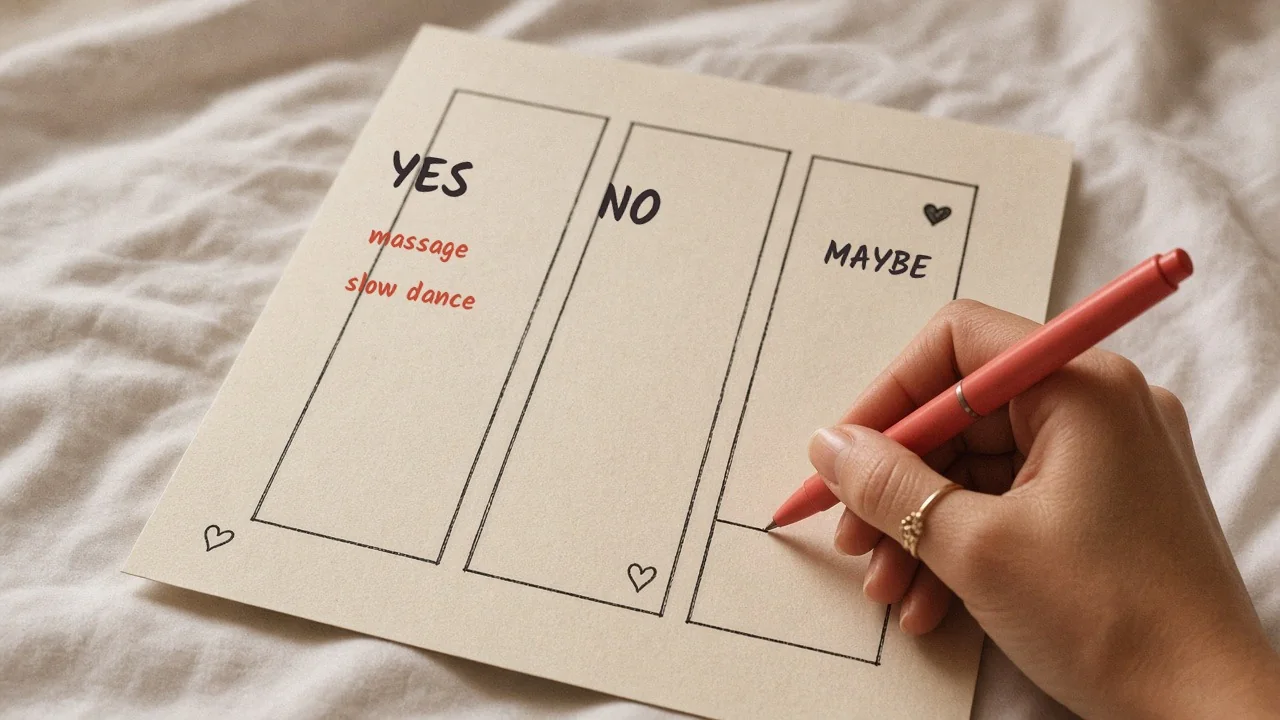
A yes/no/maybe list is exactly what it sounds like: a long list of sexual and sensual activities, from the sweet (kissing for a whole song, a massage with oil, showering together) to the adventurous (blindfolds, role play, a little light restraint, making love somewhere you might be heard). Each partner fills out their own copy privately and marks every item:
- Yes: I’m into it or I’d happily try it.
- No: a hard limit, no explanation needed.
- Maybe: I’m curious under the right circumstances, or with more conversation.
Then you compare. The overlap is your new playground.
Sex education site Scarleteen publishes a detailed version, “Yes, No, Maybe So,” and plenty of free templates float around online. You can also write your own, which, frankly, is half the fun.
Why it works (the science part)
This isn’t just bedroom folk wisdom. In a 2022 meta-analysis that pooled 93 studies covering more than 38,000 people in relationships, Ohio State researcher Allen Mallory found that couples’ sexual communication was clearly linked to both sexual satisfaction and relationship satisfaction. The link was strongest for the quality of that communication, meaning how open and constructive it is, and not just how often couples talk.
Earlier research made a similar point. A 2011 study by Montesi and colleagues found that talking specifically about sex predicted couples’ satisfaction over and above their general communication skills. You can be great at discussing finances and the in-laws and still be stuck when it comes to what happens under the sheets.
A list helps because it removes the hardest part: starting. You aren’t confessing a fantasy out of nowhere. You’re ticking a box on a piece of paper, and paper doesn’t blush.
How to do it without killing the mood
1. Pick your moment. Not in bed, not after a fight, and not when one of you is exhausted. Try a lazy Sunday afternoon or a long dinner at home. Make it feel like a date, not a performance review.
2. Fill it out separately. Give yourselves privacy and time, ideally a day or two. Be honest rather than generous. A “yes” you don’t mean helps nobody.
3. Compare only the matches first. Here’s a pro move: start by revealing only the items you both marked yes. It keeps the energy playful and stops anyone from feeling judged for a no.
4. Treat “maybe” as a door, not a wall. Maybes are where the most interesting conversations happen. Ask, “What would make that feel good to you? What would make it feel safe?” Maybe means under some conditions. Find out what they are.

5. Honor every no, instantly. No sulking, no “but why?”, no bringing it up again next week in a cute voice. A no on the list protects the yes. Knowing your boundaries will be respected is what makes people brave enough to be adventurous.
6. Make a plan, then let it be spontaneous. Choose one or two shared yeses to try in the coming weeks. Agree on a simple check-in word or signal for slowing down or stopping. Then forget the paperwork and enjoy yourselves.
Consent is the foreplay
Planned Parenthood sums up good consent with the acronym FRIES: freely given, reversible, informed, enthusiastic and specific. A yes on a list is a wonderful start, but it isn’t a contract. Anyone can change their mind on the night, mid-moment or forever, and a “yes to a blindfold” isn’t a “yes to everything that might follow.” Keep checking in, with words, with eye contact, with a whispered “still good?” Done right, check-ins don’t interrupt the heat. They often turn it up.
A word on desire that isn’t instant
If one of you fills in the list with fireworks and the other feels lukewarm, don’t panic. Sexual-medicine researcher Rosemary Basson’s model of responsive desire, popularized by sex educator Emily Nagoski in Come As You Are, helps explain why. Nagoski describes two common styles of desire. Spontaneous desire appears out of the blue. Responsive desire shows up only once things get going, after touch, closeness and the right context. Both are normal. For many people, especially in long relationships, responsive desire is the default. The list helps here too, because it tells you what kind of context gets your partner’s motor running.
Redo it every year
People change. Bodies change. Curiosity changes. Treat your list like a passport rather than a tattoo, and update it on your anniversary or whenever life shifts: a move, a baby, a new decade. The couples who keep talking are the couples who keep playing.
So tonight, pour two glasses, find two pens and give each other the gift of finally saying it out loud. Or at least ticking the box.
This article is for general education, not medical advice. If sex is causing pain, distress or conflict, talk to a doctor or a qualified sex therapist.
Sources
- Mallory, A. B. (2022). ‘Dimensions of couples’ sexual communication, relationship satisfaction, and sexual satisfaction: A meta-analysis.’ Journal of Family Psychology, 36(3), 358–371 (published online 30 December 2021). doi:10.1037/fam0000946. https://pmc.ncbi.nlm.nih.gov/articles/PMC9153093/
- Montesi, J. L., Fauber, R. L., Gordon, E. A., & Heimberg, R. G. (2011). ‘The specific importance of communicating about sex to couples’ sexual and overall relationship satisfaction.’ Journal of Social and Personal Relationships, 28(5), 591–609. doi:10.1177/0265407510386833
- Basson, R. (2000). ‘The female sexual response: A different model.’ Journal of Sex & Marital Therapy, 26(1), 51–65. doi:10.1080/009262300278641
- Nagoski, E. (2021). Come As You Are (revised and updated edition). Simon & Schuster.
- Scarleteen, ‘Yes, No, Maybe So: A Sexual Inventory Stocklist’: https://www.scarleteen.com/article/advice/yes_no_maybe_so_a_sexual_inventory_stocklist
- Planned Parenthood, ‘What is sexual consent?’: https://www.plannedparenthood.org/learn/relationships/sexual-consent