

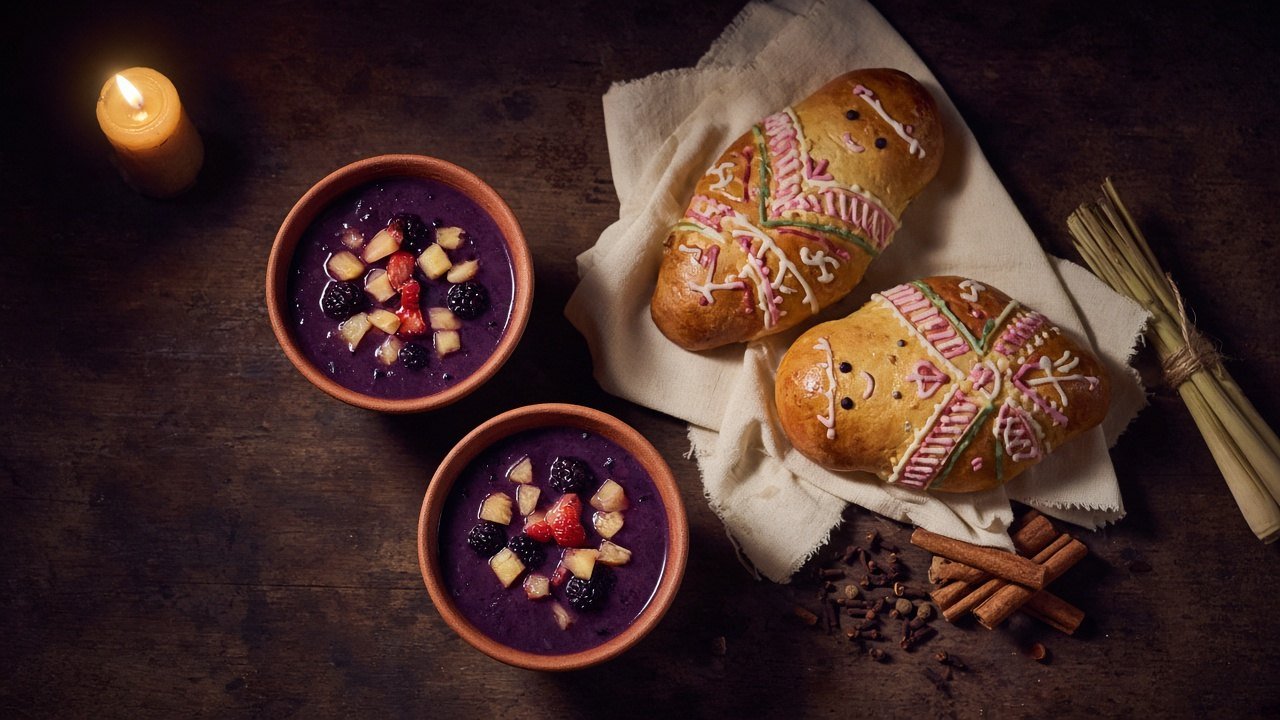
Somewhere around mid-October, Ecuador’s bakeries start to smell different. Cinnamon and cloves drift out onto the sidewalk. Hand-painted signs go up in the windows: Hay colada morada. Trays of small, sweet breads shaped like swaddled babies, with icing faces, appear on every counter. By the first days of November, pretty much the whole country, from Quito office workers to grandmothers in Otavalo to surfers in Montañita, is drinking the same thick purple drink.
Halloween is fine. But Ecuador’s way of honoring its dead is warmer, sweeter and much older.
What’s in the cup
Colada morada is somewhere between a drink and a dessert: a hot or cold fruit porridge, thickened with purple corn flour and loaded with fruit, herbs and spices. A typical family recipe includes:
- Purple or black corn flour (harina de maíz morado), for body and color
- Mortiño, a small wild Andean blueberry, and blackberries, for that deep violet
- Naranjilla, pineapple, strawberries and babaco, chopped and stirred in at the end
- Hierba luisa (lemongrass), arrayán (myrtle) and ataco (amaranth leaves), steeped for perfume and color
- Cinnamon, cloves, allspice and the secret weapon, ishpingo, the dried flower cup of a native Amazonian tree with a warm, cinnamon-like scent
- Panela to sweeten it
That’s often 15 or more ingredients, and every family insists theirs is the correct ratio. It’s served with guaguas de pan for dipping. That isn’t optional.
The bread babies
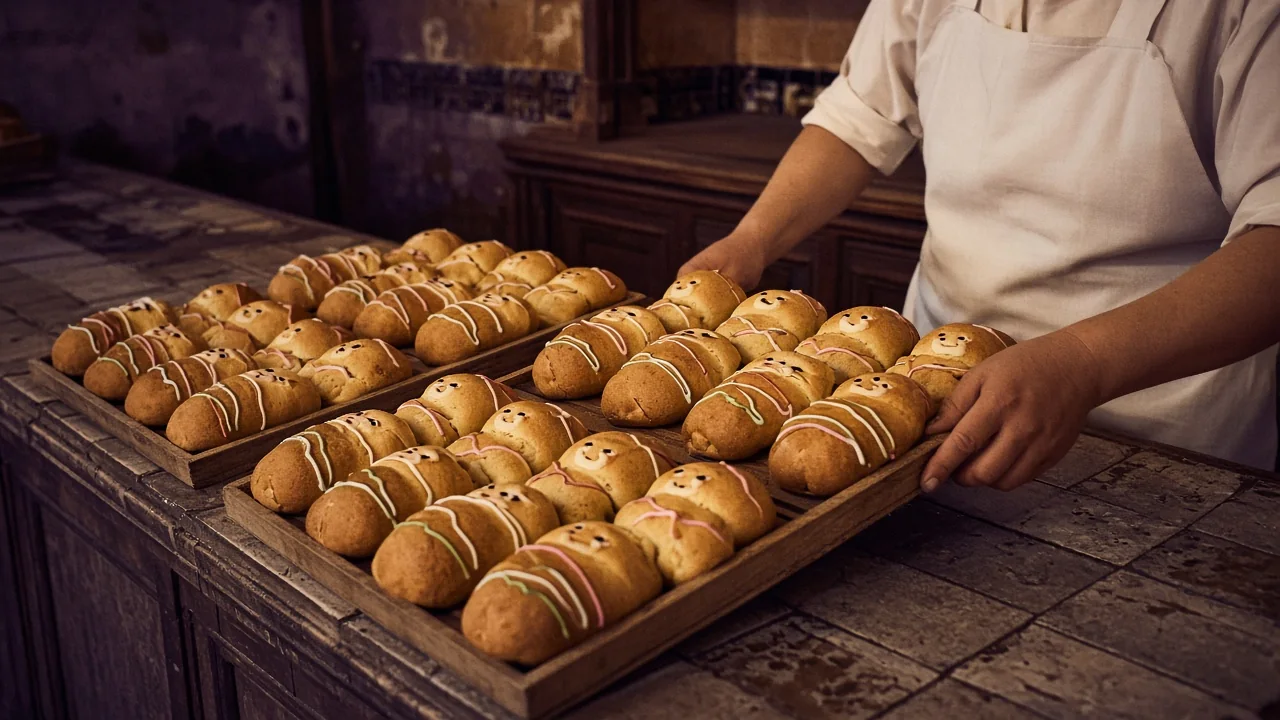
Guagua means child in Kichwa, and a guagua de pan is a sweet bread shaped like a swaddled baby, decorated with brightly colored icing: a face, a little bonnet, patterns on the blanket. Many bakeries now fill them with guava jam, though purists such as the food scholar Julio Pazos insist the traditional bread was plain, since sweet bread with sweet colada is too much. Bakeries, markets and street stalls sell them throughout October, and families buy them by the dozen for the Day of the Dead, Día de los Difuntos, on 2 November.
They look adorable. They’re also, quite literally, symbols of the departed.
Older than the calendar
Historians and anthropologists who have studied the tradition link it to pre-Hispanic Andean rituals for the dead. Spanish chroniclers wrote that Andean peoples believed the spirits of the dead felt hunger and thirst, so families visited the tombs with food and fermented corn chicha. Pazos points out that the colada still shares two things with an old ritual chicha: fermented corn and ishpingo. In Calderón, north of Quito, the season is still celebrated as Aya Markay Killa, a festival of sharing colada and guaguas with the dead.
The paper trail is thinner than the legend, though. A Jesuit described a purple corn porridge spiced with cinnamon and cloves in 1771, and the first written mention of “guaguas de pan” and purple mazamorra for the Day of the Dead dates from 1900.
When the Spanish arrived and brought the Catholic feasts of All Saints and All Souls, the old practices didn’t disappear. They went undercover. In a 2021 lecture, the Ecuadorian writer and food scholar Julio Pazos described these as “strategies of concealment”: rituals that kept their Andean heart inside a Catholic calendar. The corn drink, the bread figures and the shared meal survived by changing their clothes.
Some Indigenous communities in the highlands still take food to the cemetery on 2 November and share it at the graves with the dead, the living and passing neighbors. In the cities, the ritual has mostly moved to the kitchen table. But the idea is the same: you eat and drink with the people you’ve lost, not just about them.
From bread to art: the masapán of Calderón
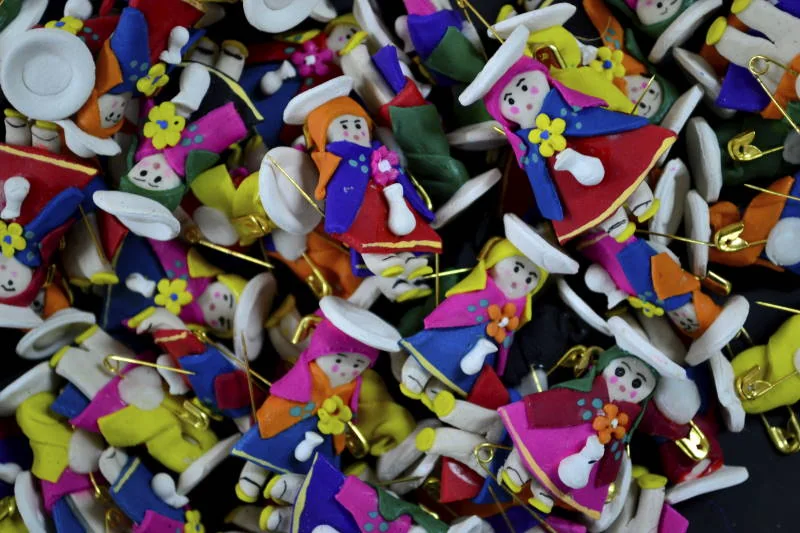
In Calderón, on the northern edge of Quito, the bread figures took on a second life. In 1938, according to her family’s account to the newspaper El Telégrafo, a local baker named Margarita Reza Povea began experimenting with the dough and pigments of her guaguas de pan. She made bigger, non-edible figures and eventually sealed them with a glossy coat to protect the colors. Bread babies grew arms and bonnets, then became dancers, devils and market women, and she trained local women in the craft. Today Calderón’s masapán figures are sold as souvenirs, Ecuador’s National Assembly declared them Intangible Cultural Heritage in 2018, and the parish still marks Día de los Difuntos with ancestral traditions.
Make it at home (the lazy-but-honest version)
Real colada takes an afternoon. Here’s a shortcut that still tastes like November in Quito. It serves six.
- Make the spiced water. Simmer 2 liters of water with 2 cinnamon sticks, 6 cloves, 4 allspice berries, a few pieces of ishpingo if you can find it, and a handful each of hierba luisa and arrayán (or lemongrass and a bay leaf) for 20 minutes. Strain.
- Make the berry base. Blend 2 cups of blackberries and 1 cup of mortiño (or blueberries) with a little water and strain out the seeds.
- Thicken. Whisk 1 cup of purple corn flour into 2 cups of cold water, then stir it into the spiced water with the berry purée and 200 g of grated panela. Cook over medium heat, stirring constantly, for 20–30 minutes until it coats a spoon.
- Finish. Off the heat, stir in diced pineapple, strawberries and babaco or naranjilla. Serve warm or cold.
Pair it with guaguas from a good bakery. Or bake your own if you’re feeling brave.
Why it matters now
In a country that has had a hard few years, colada morada season is a rare moment when everyone agrees on something. It’s family recipes argued over by text, office trays shared with coworkers, and expats invited into neighbors’ kitchens for the first time. It’s grief made sweet and shared.
So if you’re in Ecuador this week, go find a cup. Ask the person who serves it how their grandmother made it. Then raise your guagua to someone you miss.
Sources
- Anthropía (PUCP), ‘Reflexión histórica de la colada morada, tradicional bebida del Ecuador’: http://revistas.pucp.edu.pe/index.php/anthropia/article/view/27330
- Academia Ecuatoriana de la Lengua, Julio Pazos Barrera, ‘Estrategias de ocultamiento: colada morada y pan de finados’ (lecture, 28 October 2021; ingredients, early written records, ritual roots): http://www.academiaecuatorianadelalengua.org/estrategias-de-ocultamiento-colada-morada-y-pan-de-finados-por-don-julio-pazos-barrera/
- Quito Informa, ‘Calderón conmemora el Día de los Difuntos con tradiciones ancestrales’ (October 2024): https://www.quitoinforma.gob.ec/2024/10/28/calderon-conmemora-el-dia-de-los-difuntos-con-tradiciones-ancestrales/
- El Telégrafo, ‘Figuras de mazapán tienen 8 décadas de historia’ (29 May 2018; Margarita Reza Povea, 1938): https://www.eltelegrafo.com.ec/noticias/quito/1/figuras-mazapan-tradicion-calderon-quito