

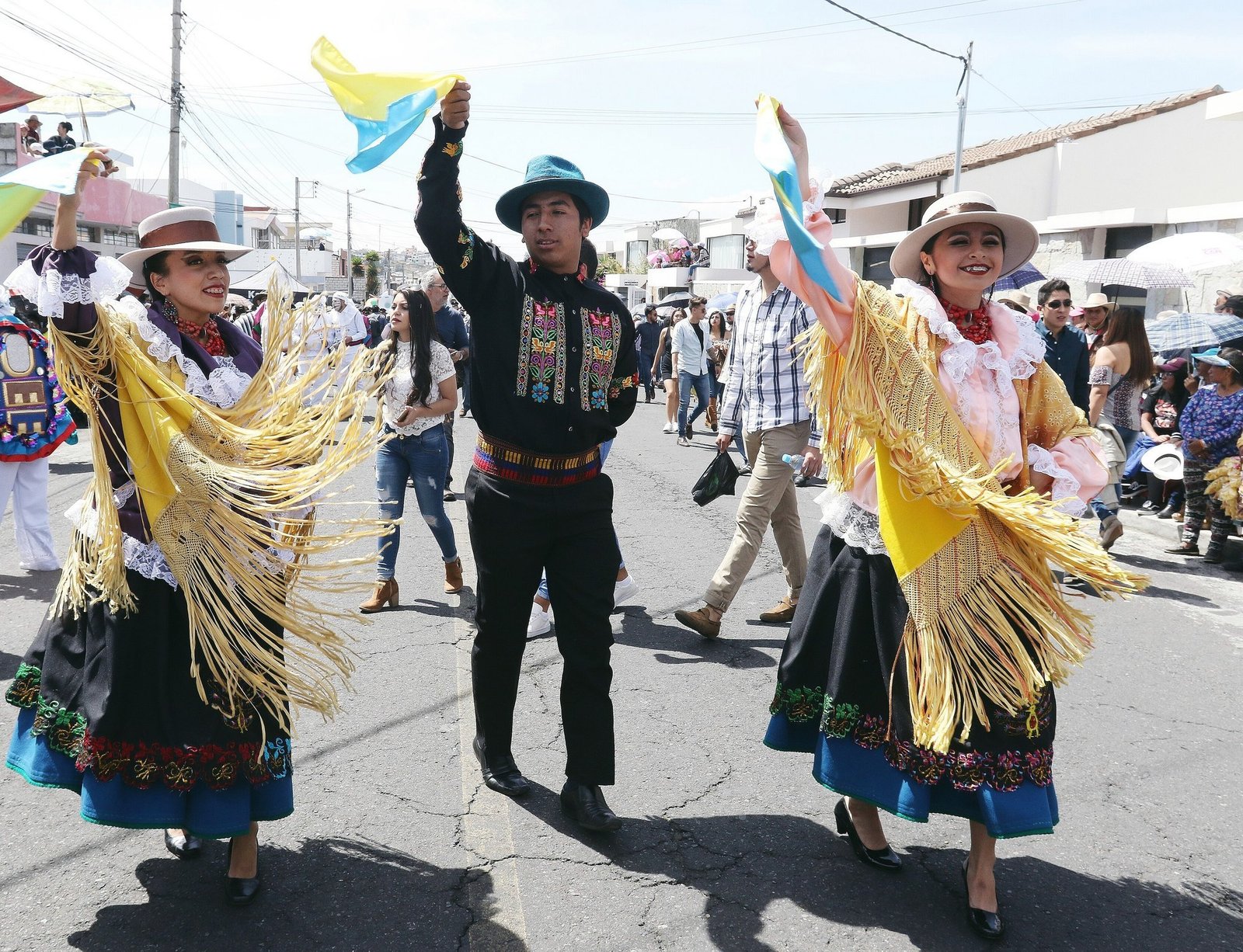
Latacunga is usually a quiet stop on the Panamericana, the city you pass on the way to Quilotoa or Baños. Once a year in November, it becomes the loudest city in the Andes. Brass bands play for hours, dancers in mirrored costumes spin through the streets, and a man dressed as the Mama Negra rides by on horseback, spraying the crowd with milk and water from a bottle. You will get wet. That’s part of it.
This year, the main parade is on Saturday 7 November 2026, starting at 09:00 from the Plaza de Toros San Isidro Labrador on Avenida 11 de Noviembre, according to the Municipio’s cultural agenda.
Two Mama Negras, not one
Latacunga actually has two Mama Negra celebrations, which confuses a lot of visitors.
- September (religious). The original festival, held around 23–24 September, is organised by the market vendors of La Merced in honour of the Virgen de la Merced.
- November (civic). This is the big one, organised by the Municipio around the anniversary of Latacunga’s independence on 11 November 1820. Sometimes called the Mama Negra de la Capitanía, it brings the largest crowds.
Both share the same characters and much of the same spirit. This guide is about November.
Where it comes from
Nobody fully agrees, and that’s part of the story.
- The volcano theory. The best-known version links the fiesta to Cotopaxi. After the volcano’s activity in 1742, the people of Latacunga are said to have turned to the Virgen de la Merced, naming her “Abogada y Patrona del Volcán” (advocate and patron of the volcano), and celebrating her protection.
- The freedom theory. Another version traces the Mama Negra to a celebration by enslaved and formerly enslaved Black people, linked to the Sigchos area, marking their liberation in the mid-19th century.
- The modern parade. The November civic version dates from 1963. It was an idea credited to Rafael Sandoval Pástor, founder of the local newspaper La Gaceta, and was then institutionalised by the municipality.
In 2005, the Mama Negra was declared part of Ecuador’s Intangible Cultural Heritage.
Who’s who in the parade
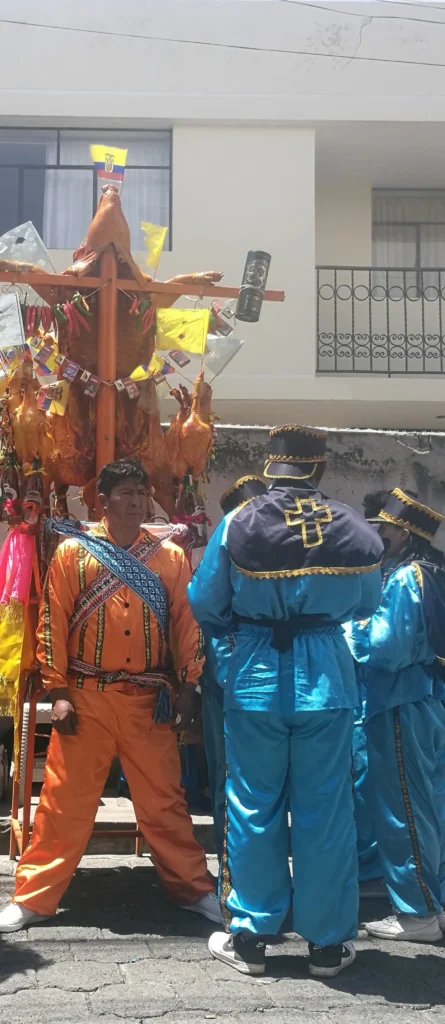
The parade is built around a cast of traditional characters, each played by a man chosen months in advance. Being picked is a big honour, and an expensive one: characters traditionally fund food, drink, music and costumes for their comparsas (troupes).
- La Mama Negra. Always played by a man, his face painted black, on horseback, holding a doll known as Baltasara and spraying milk and water over the crowd.
- El Ángel de la Estrella. Representing the Archangel Gabriel, also on horseback, reciting verses called loas.
- El Rey Moro. The Moorish King, in rich robes, with his escort.
- El Abanderado. The standard-bearer, waving a huge chequered flag.
- El Capitán. The captain who leads the military-style column.
Around them move dozens of other figures. Huacos perform limpias (ritual cleansings) on spectators. Ashangueros carry the ashanga, a heavy frame loaded with a whole roast pig, cuyes, bottles and fruit. Camisonas wear lace and petticoats, payasos (clowns) tease the crowd, and yumbos represent peoples of the Amazon.
This year’s cast, presented in September, is:
- Mama Negra: José Marcelo Mogro Gallardo. He’s the son of Jorge Mogro Barriga, one of the early figures of the November Mama Negra.
- Ángel de la Estrella: Alejandro Sebastián Fabara Torres
- Rey Moro: Carlos Andrés Tovar Amores
- Abanderado: Luis Rodrigo Cepeda Valverde
- Capitán: Francisco Javier Mullo Sosa
One change this year: according to La Gaceta, Latacunga’s mayor, who traditionally takes part as prioste mayor, won’t parade because of the electoral process (local elections are on 29 November). The vice-mayor (the vicealcaldesa) is due to stand in for the mayor.
A conversation worth knowing about
The Mama Negra’s black face paint is a subject of real debate, inside and outside Ecuador. For many latacungueños, it’s a symbol of devotion, identity and the city’s mixed heritage. Critics, including Afro-Ecuadorian voices and researchers, ask what it means for a non-Black man to perform a Black woman in black face paint, and whose history is being told. Academic work such as Daniela Schneider’s study of the fiesta in the journal Indiana explores exactly that tension.
You don’t need to settle the debate to attend. It’s worth knowing it exists, and listening if someone raises it.
How to enjoy it
- Get there early. Streets around the centre fill fast. Find a spot along the route well before the start; the historic centre around Parque Vicente León is the heart of the action.
- Know the start, check the route. The Municipio’s agenda puts the start at 09:00 at the Plaza de Toros San Isidro Labrador, Avenida 11 de Noviembre, but the full street route hadn’t been published when we checked. Look at its official social channels the day before. Barriers along the route go up from 14:00 on Friday 6 November.
- Pay fair for a seat, or stand for free. Watching from the street costs nothing. If you want to sit, the Municipio has capped prices at $3 for a chair and $5 for a spot on the raised stands, according to La Gaceta.
- Come early for the build-up. The Vísperas (eve celebration) are on Thursday 5 November at 18:00 in Plaza El Salto, and an exhibition of Baltasara dolls runs from Friday 6 November at the Maltería Plaza mall.
- Dress for it. Wear clothes you don’t mind getting splashed, layers (Latacunga is at about 2,860 metres and the afternoons can turn cold), sunscreen and a hat.
- Be smart with valuables. Crowds are dense. Carry little, keep your phone in a front pocket and agree a meeting point with friends.
- Say yes to a limpia, or politely no. Huacos may approach you. It’s friendly, but it’s fine to decline with a smile.
- Drink sensibly. Alcohol flows freely, but it’s a long day, and you’ll want to remember the music.
What to eat
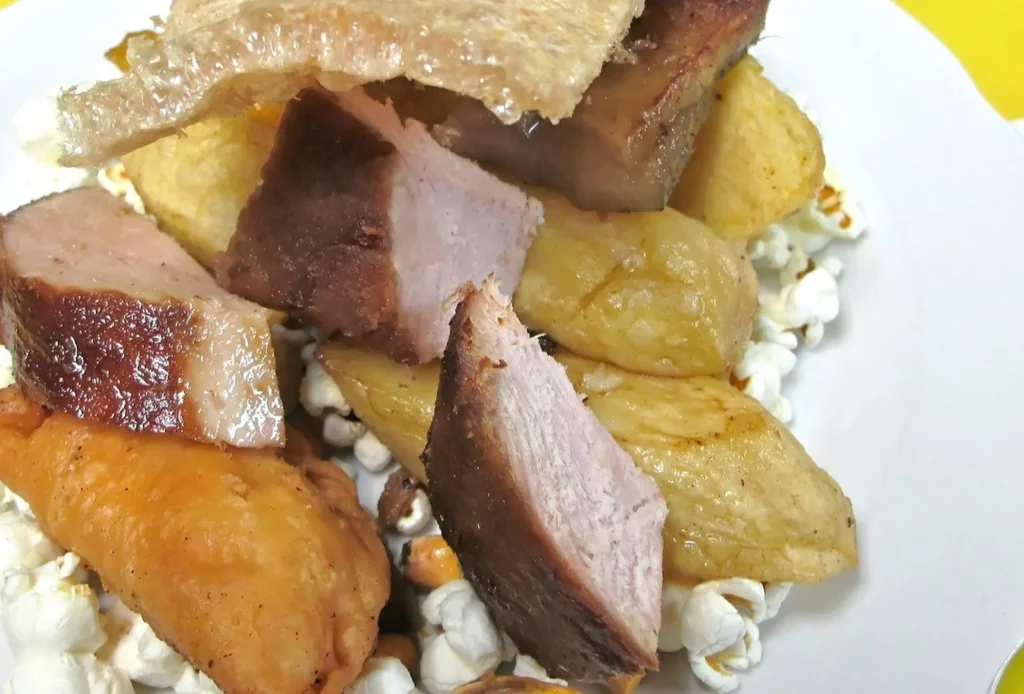
Don’t leave Latacunga without chugchucaras. The name is usually translated from Kichwa as “trembling skin”, and the dish has been a Latacunga staple for more than 70 years: fried pork, crackling, mote, fried plantain, potatoes, an empanada, popcorn and toasted corn, all on one plate. Share it.
For the road, buy allullas, crumbly local biscuits, with queso de hoja, a fresh cheese wrapped in an achira leaf.
Getting there and making a weekend
Latacunga is about 90 kilometres south of Quito. Buses leave regularly from Quitumbe and take around two hours, longer on parade weekend, so leave early. Book a room well ahead if you want to stay.
Pair it with a hike: Cotopaxi National Park sits just north of the city (our Cotopaxi guide this week has the details), and the Quilotoa Loop starts just to the west. If you collect November fiestas, compare it with the Fiestas de Cuenca. If you missed the Day of the Dead, there’s still time for colada morada and guaguas de pan. And if the brass bands get under your skin, read why live music is going intimate.
The Mama Negra is loud, crowded and a little chaotic. Go anyway. It’s one of the best days of the year in the Ecuadorian Andes.
Checked on 2 November 2026. Dates, times, routes and participants can change. Confirm with the Municipio de Latacunga before you travel.
Sources
- La Gaceta, ‘La Mama Negra dinamiza la economía y reactiva los negocios de Latacunga’: https://lagaceta.com.ec/la-mama-negra-dinamiza-la-economia-y-reactiva-los-negocios-de-latacunga/
- La Gaceta, ‘Alcalde de Latacunga no participará en el desfile de la Mama Negra de noviembre’ (25 October 2026): https://lagaceta.com.ec/alcalde-de-latacunga-no-participara-en-el-desfile-de-la-mama-negra-de-noviembre/
- Al Día, Mama Negra 2026 coverage: https://aldiaonline.net/?p=225881
- El Telégrafo, ‘Latacunga calienta motores: se presentan los cinco personajes de la Mama Negra 2026’ (9 September 2026): https://www.eltelegrafo.com.ec/noticias/locales/232/latacunga-calienta-motores-se-presentan-los-cinco-personajes-de-la-mama-negra-2026
- Festipath, ‘Mama Negra’ (heritage status and 2025 parade figures): https://festipath.com/es/festivals/mama-negra
- Wikipedia (es), ‘Mama Negra’ (origin theories and history of the November edition): https://es.wikipedia.org/wiki/Mama_Negra
- Schneider, D., ‘La Mama Negra – ¿símbolo de la multiculturalidad ecuatoriana?’, Indiana 24 (2007), 157–171: https://doi.org/10.18441/ind.v24i0.157-171
- Ministerio de Turismo, chugchucaras: https://www.turismo.gob.ec/56206-2/
- Ministerio de Turismo, allullas and queso de hoja: https://www.turismo.gob.ec/56605-2/
- Ecuraíces, ‘Latacunga celebra 206 años de emancipación política con tradición’ (Municipio de Latacunga Agenda Cultural 2026): https://www.ecuraices.com/cultura/fiestas-ecuador/latacunga-celebra-206-anos-de-emancipacion-politica/
- La Gaceta, ‘Autoridades fijaron precios máximos para sillas y graderíos en la Mama Negra’ (22 October 2026): https://lagaceta.com.ec/autoridades-fijaron-precios-maximos-para-sillas-y-graderios-en-la-mama-negra/
- Cover photo: PHOTO: “FIESTA DE LA MAMA NEGRA (38115342906)” BY AGENCIA DE NOTICIAS ANDES / WIKIMEDIA COMMONS (CC BY-SA 2.0), EDITED